Luxury Beach Resorts USA: The Definitive Evaluation Guide
Coastal high-end hospitality within the United States occupies a distinct intersection of real estate geography, marine environmental engineering, local zoning constraints, and complex revenue management systems. Unlike urban grand hotels engineered primarily around corporate transient turnover or isolated mountain retreats operating on seasonal weather cycles, coastal properties must balance fragile marine ecosystems, severe storm protection mandates, saltwater infrastructure maintenance, and high guest expectations for seclusion and service velocity. From the wind-swept bluffs of the Pacific Northwest and the rugged coves of central California to the coral-fringed keys of Florida and the historic shores of New England, domestic oceanfront properties face intense operational friction.
Analyzing high-end coastal properties requires moving past promotional marketing imagery to examine the structural mechanics of waterfront asset management. A property’s ability to deliver consistent service velocity, maintain saltwater-resistant physical infrastructure, manage coastal erosion, and execute precise culinary and wellness programs depends entirely on how its physical layout interacts with local municipal codes and revenue engines. Whether evaluating a private island hideaway in the Florida Keys or a historic Victorian seaside estate in Rhode Island, understanding the structural mechanics of high-end coastal hospitality is essential for travel planners, asset managers, and analytical consumers.
Evaluating the top tier of coastal properties demands examining distribution channel priority, baseline rate integrity, marine environmental vulnerability, ancillary cost unbundling, and service continuity during seasonal weather transitions. What appears to a guest as effortless oceanfront relaxation is the output of precise resource allocation, marine infrastructure hardening, local seafood supply-chain logistics, and rigorous physical property maintenance.
Understanding “luxury beach resorts USA.”
Evaluating the market of luxury beach resorts USA requires looking past subjective consumer reviews, social media marketing, and broad award listings. From an asset management, operational, and hospitality distribution perspective, assessing top-tier coastal inventory demands an analytical methodology. It involves evaluating distribution channel mechanics, staff-to-guest operational ratios, architectural spatial geometry, marine environmental resilience, and total cost of stay metrics across distinct regional maritime environments.
Systematically auditing coastal property performance involves examining three primary operational layers:
-
Spatial Footprint and Maritime Setbacks: Evaluating physical key density per acre, coastal building setbacks, sea-level rise mitigation structures, acoustic insulation standards against wave action, and visual privacy sightlines.
-
Distribution Channel Priority and Rate Integrity: Assessing how property management systems (PMS) handle direct brand channels, luxury travel consortia networks (e.g., Virtuoso, Preferred Partner programs), and wholesale distribution channels to maintain rate parity and upgrade priority.
-
Service Velocity and Marine Maintenance Infrastructure: Measuring the staff-to-guest ratio alongside specialized engineering resources required to maintain corrosion-resistant architectural finishes, private beach grooming, and saltwater pool systems.
A common failure mode in coastal travel procurement is treating published room tariffs as uniform indicators of spatial quality or direct beach access. A traveler observing identical $1,500 baseline nightly tariffs across two competing oceanfront properties may assume the resulting physical stay experiences will be equivalent. In reality, one property may offer a detached bungalow on a wide, private white-sand beach with unobstructed maritime views, while another provides a standard guest room in a high-density 300-key coastal tower where secondary daily facility fees, mandatory valet tariffs, and seawall concrete barriers obscure the natural shoreline.
Deep Contextual Background: The Evolution of American Coastal Hospitality
The architecture of American coastal resort hospitality has evolved through distinct economic, technological, and real estate phases over the past two centuries. In the 19th and early 20th centuries, coastal travel centered on grand railway termini and sprawling Victorian timber hotels in New England, Atlantic City, and early Florida coastal outposts. Properties operated on straightforward American Plan structures, offering shared communal dining halls, fixed daily schedules, and large grand-hotel main buildings. Inventory controls were rigid, rates were published in static print ledgers, and unbundled secondary fees did not exist.
The mid-20th-century expansion of commercial aviation and high-speed coastal highway networks reshaped domestic travel geometry. Developers began constructing sprawling, low-density tropical island enclaves, barrier island resorts, and Pacific cliffside retreats across Florida, Hawaii, California, and the Carolinas. During this era, hoteliers introduced specialized architectural formats designed for individual maritime privacy, such as beachfront casitas, private plunge pool suites, and stilted overwater or dune-adjacent pavilions. However, operating low-density, spatially expansive properties in highly corrosive marine environments increased utility, labor, and structural maintenance overhead, forcing operators to elevate Average Daily Rates (ADR) and introduce unbundled amenity charges.
In the late 1990s and 2000s, the digitalization of hotel reservation networks and the consolidation of luxury corporate brands reshaped asset distribution. High-end hoteliers partnered with luxury travel consortia and credit card concierge networks to create closed-user-group rate structures. These codes preserved public rate parity while bundling high-value amenities—such as daily full breakfast, property credits, room category upgrades, and flexible check-in times—into high-tier reservations. Today, evaluating American coastal properties requires navigating an environment where mega-luxury brand networks, independent historical seaside estates, eco-island sanctuaries, and digital travel aggregators compete for guest capital.
Conceptual Frameworks and Mental Models for Coastal Asset Evaluation
Systematic evaluation of coastal resort inventory requires analytical mental models that move past promotional marketing to isolate the core drivers of net value, spatial quality, and structural resilience.
1. The Shoreline Proximity to Key Density Ratio (SPKDR)
This framework calculates the ratio between the linear footage of private accessible beachfront and the total physical room key count of a coastal property. High-performance coastal sanctuaries maintain high linear beach footage per key, ensuring expansive spatial privacy, uncrowded beachfront cabanas, and wide physical separation between guest accommodations. High key density relative to minimal shoreline indicates an urbanized or high-rise coastal format where public beach access, pools, and dining venues suffer from visual and acoustic crowding during peak occupancy windows.
2. The True Net Stay Cost Metric (TNSCM)
This model calculates the complete financial outlay of a coastal stay by combining baseline room tariffs, mandatory daily facility charges, localized lodging taxes, parking surcharges, estimated food and beverage expenses, and transport outlays, minus the open-market value of bundled inclusions like daily full breakfast, resort credits, or complimentary transfers.
3. The Marine Maintenance to Service Velocity Index (MMSVI)
This framework measures the ratio of structural engineering and corrosion-mitigation maintenance outlays relative to front-of-house service staff budgets. Premier coastal properties invest heavily in specialized marine upkeep to ensure that salt air degradation, woodwork rot, and dune erosion do not impact the guest experience, maintaining flawless service velocity alongside pristine architectural integrity.
Key Categories and Structural Variations in Waterfront Hospitality
The domestic coastal hospitality market contains distinct operational and spatial categories, each structured to balance geographic footprints, guest demographics, service delivery mechanisms, and property business models.
| Resort Category | Primary Operational Focus | Spatial & Key Footprint | Financial & Tariff Structure | Primary Operational Trade-Off / Vulnerability |
| Private Island Enclaves | Absolute isolation, maritime privacy, seaplane transit | Extremely low key density; detached beach bungalows | High baseline ADR; inclusive or high unbundled tariffs | Vulnerable to tropical storm logistics; high transfer costs |
| Pacific Bluff Sanctuaries | Dramatic ocean views, marine wildlife, cool microclimates | Low-to-mid density; cliffside or hillside footprints | High seasonal ADR peak multipliers; high à la carte outlays | Fog/wind weather shifts; steep terrain walking friction |
| Historic Victorian Seaside Estates | Legacy heritage, classic beach culture, multi-generational | Sprawling multi-building grounds; high key count | Unbundled European Plan + mandatory facility fees | Outdated acoustic insulation in historic wings; tight parking |
| Barrier Island Resorts | Expansive white-sand beaches, water sports, family leisure | Low-rise campus footprints; moderate key density | Seasonal rate variance; unbundled cabana/resort fees | High hurricane exposure; storm surge vulnerability |
| Tropical Key Sanctuaries | Coral reef proximity, yachting culture, warm waters | Low-rise bungalow layouts; low key count | Premium nightly rates; high marine excursion markups | High humidity; seasonal algae/seaweed wash events |
| New England Maritime Refuges | Yachting heritage, private coves, culinary focus | Intimate coastal footprints; low key count | High summer peak multipliers; winter seasonal closures | Short peak operating window; high off-season maintenance costs |
Exemplary Coastal Resort Profiles
To understand how these categories function operationally across different maritime regions, consider several flagship domestic properties that exemplify specific architectural and service models:
Little Palm Island (Little Torch Key, Florida)
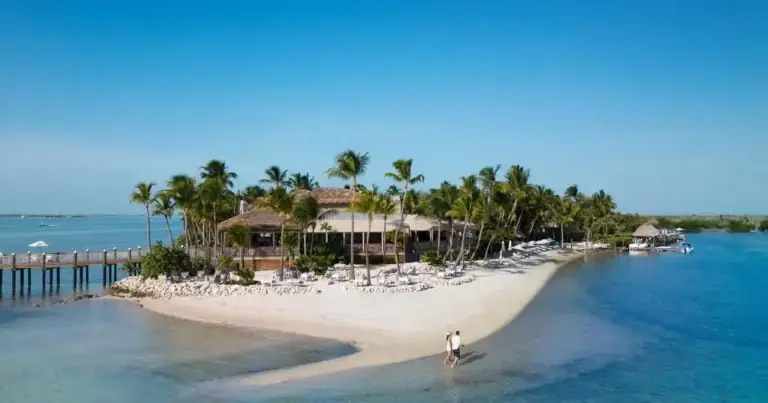
A private four-acre island resort located in the Florida Keys, accessible exclusively via seaplane or private resort ferry. The resort features 30 thatched-roof oceanfront bungalows free of televisions and phones, emphasizing complete digital detoxification. It offers private white-sand beaches, an oceanfront pool, a full-service spa, and fine dining at The Dining Room.
-
Strengths: Complete island isolation, adults-only quiet atmosphere, and authentic tropical island living within the continental United States.
-
Trade-Offs: Susceptible to Atlantic hurricane weather volatility, with high transfer tariffs and limited spatial land acreage for long-distance walking.
Post Ranch Inn (Big Sur, California)
A high-elevation coastal bluff retreat perched 1,200 feet above the Pacific Ocean along California’s Highway 1 corridor. The property features 40 rustic-chic rooms, suites, and freestanding treehouses constructed from reclaimed wood and floor-to-ceiling glass. It provides cliffside infinity soaking pools, an award-winning farm-to-table restaurant, and dedicated wellness programs focused on meditation and stargazing.
-
Strengths: Spectacular natural ocean views, absolute adults-only quiet, and eco-friendly architectural integration.
-
Trade-Offs: Susceptible to Highway 1 weather closures and coastal fog, with steep terrain requiring moderate physical walking mobility across the grounds.
Ocean House (Watch Hill, Rhode Island)
A restored historic Victorian seaside resort positioned along a private stretch of Atlantic coastline in southern New England. The property features 49 rooms and 20 multi-bedroom signature suites decorated in classic coastal yellow-and-white architectural styling. It provides a private cabana-serviced beach, a 12,000-square-foot spa, dedicated croquet lawns, and farm-to-plate culinary programming.
-
Strengths: Authentic historic seaside atmosphere, direct Atlantic beach access, and flawless Forbes Five-Star service standards.
-
Trade-Offs: Extreme seasonal rate variance between summer peak and winter low seasons, with tight parking and village traffic during July and August.
Montage Laguna Beach (Laguna Beach, California)
A sprawling arts-and-crafts-style coastal resort perched on a 30-foot bluff overlooking 30 acres of Pacific shoreline in Southern California. The property features 250 guest rooms, suites, and multi-bedroom craftsman villas, alongside extensive lawn spaces, two outdoor mosaic pools, and a 20,000-square-foot holistic spa.
-
Strengths: Prime Southern California coastal positioning, exceptional family and couples infrastructure, and direct access to pristine tide pools and sandy coves.
-
Trade-Offs: Higher key density than boutique island retreats, creating active guest traffic across central lobby and pool concourses during summer weekends.
The Cloister at Sea Island (Sea Island, Georgia)
A classic Spanish Revival luxury resort situated on a private barrier island along the Georgia coast, offering five miles of private Atlantic beach. The property features extensive architectural detailing, a yacht club, three championship golf courses, a world-class shooting school, and comprehensive children’s and tennis programs.
-
Strengths: Deep southern hospitality heritage, vast recreational land footprint, and family-oriented barrier island infrastructure.
-
Trade-Offs: Expansive resort campus requires shuttle transportation between remote residential cottages and central beach clubs.
Halekulani (Honolulu, Hawaii)
An iconic beachfront sanctuary positioned along the Waikiki shore in Oahu, known for its understated elegance and minimalist white-on-white interior design. The property features 453 rooms and suites oriented toward the Pacific Ocean and Diamond Head, anchored by its legendary heated swimming pool featuring a Cattleya orchid mosaic embedded in the bottom.
-
Strengths: Unrivaled Pacific Oceanfront positioning within an urban resort setting, legendary culinary programs, and immaculate service standards.
-
Trade-Offs: Urban Honolulu surroundings introduce ambient street noise in select rooms, requiring careful floor-level selection for complete acoustic quiet.
Rosewood Miramar Beach (Montecito, California)
A sophisticated beachfront estate occupying 16 acres along the Santa Barbara coastline, designed to evoke a grand seaside private residence. The property features 161 ultra-luxury guest rooms, suites, and beachfront studio suites with direct sand access, supported by multiple dining venues and two pristine swimming pools.
-
Strengths: Direct beach access in an ultra-exclusive residential enclave, seamless indoor-outdoor California architecture, and private train station connectivity.
-
Trade-Offs: Premium pricing tiers reflect the high-wealth micro-market of Montecito, with strict demand caps during peak holiday periods.
The Nantucket Hotel & Resort (Nantucket, Massachusetts)
A restored historic landmark hotel originally established in 1891, offering classic island resort living within walking distance of Nantucket Town. The property features traditional shingle-style architecture, fully appointed residential suites and cottages, two heated outdoor swimming pools, and a comprehensive health club and spa.
-
Strengths: Complete historic island immersion, pedestrian proximity to town dining and boutiques, and family-friendly resort programming.
-
Trade-Offs: Strict seasonal operating windows (closed during mid-winter months) and intense summer island ferry/air travel logistics.
Realistic Decision Logic for Property Selection
Selecting among these top-tier properties requires matching individual travel priorities with property operational parameters:
-
Seeking Absolute Island Isolation & Digital Detox: Select Little Palm Island or Post Ranch Inn. These low-density, adult-focused retreats eliminate urban noise, limit physical room key counts, and prioritize architectural privacy above all else.
-
Prioritizing Multi-Generational Leisure & Extensive Activities: Choose Montage Laguna Beach or The Cloister at Sea Island. These premier coastal resorts provide deep recreational infrastructure—including championship golf courses, tennis complexes, beach clubs, and varied dining outlets—that accommodate diverse age groups within a single stay.
-
Targeting Classic Maritime Heritage & Walkable Town Access: Deploy Ocean House or The Nantucket Hotel & Resort. Positioning guests within historic coastal enclaves combines direct beach access with pedestrian proximity to regional cultural and culinary hubs.
Which type of coastal setting fits your upcoming travel plans best—a private tropical island enclave, a dramatic Pacific bluff sanctuary, or a historic New England seaside resort?
Detailed Real-World Scenarios and Operational Stress Testing
To analyze how top-tier coastal resorts perform under operational strain, consider four detailed scenarios involving specific constraints, structural decision points, and potential failure modes.
High-Occupancy Holiday Travel at a Barrier Island Resort
-
Constraints: A family of four books a five-night stay at a top-tier Florida barrier island resort during peak winter holiday capacity; reservation executed via a low-tier third-party OTA portal to save 10 percent upfront.
-
Decision Points: Selecting a standard guest room without purchasing an upgraded oceanfront tier or preferred consortia package.
-
Failure Modes: Upon arrival, the resort is operating at 100 percent physical capacity with heavy beach club traffic. The family’s room key resolves to a ground-floor unit directly above a main service driveway and parking garage exhaust fan.
-
Second-Order Effects: Acoustic intrusion disrupts sleep. Front-desk staff are unable to execute a room move due to full property capacity, and beach cabana rentals are fully booked for the duration of the stay.
Scenario B: Tropical Storm Disruption at an Island Enclave
-
Constraints: A couple books a private oceanfront bungalow at a Florida Keys retreat during late autumn hurricane shoulder season to capture a 35 percent rate discount.
-
Decision Points: Balancing low package rates against statistical tropical storm forecasts in a region known for maritime weather shifts.
-
Failure Modes: A late-season tropical depression grounds seaplane and ferry transfers, delaying check-in by 24 hours and forcing emergency evacuation of low-lying beach docks.
-
Second-Order Effects: Guests experience severe travel disruption and mandatory shelter protocols, highlighting the logistical vulnerabilities of isolated island operations during adverse weather events.
Unbundled Secondary Fee Accumulation at a California Coast Estate
-
Constraints: Travelers book an advertised “Luxury Coastal Escape” at a California estate charging a baseline rate of $1,400 per night.
-
Decision Points: Assuming the headline room rate covers core amenities without auditing fine-print exclusion terms.
-
Failure Modes: Upon check-in, the guests discover that valet parking costs $75 daily, mandatory resort facility fees add $85 per night, beachfront cabana rentals carry a $300 per day surcharge, and local environmental taxes must be settled at checkout.
-
Second-Order Effects: Unbundled secondary fees add $1,500 to the final checkout folio, exceeding the couple’s incidental budget and creating administrative friction.
Dining Reservation Bottlenecks During Short Stays
-
Constraints: A couple books a three-night stay at a renowned coastal luxury estate featuring three signature fine-dining restaurants.
-
Decision Points: Relying on the front desk to arrange dinner reservations upon physical arrival rather than executing pre-arrival concierge outreach.
-
Failure Modes: Arriving on-property to find that prime dining slots (7:00 PM to 8:30 PM) across all signature outlets were fully booked weeks in advance by long-stay guests using the resort’s pre-arrival app.
-
Second-Order Effects: The couple is forced into late 9:30 PM dining slots or off-property dining options, disrupting their evening schedule and degrading the overall retreat atmosphere.
Planning, Cost, and Resource Dynamics
Evaluating coastal resort expenditure requires a clear understanding of baseline rates, mandatory secondary surcharges, dynamic yield adjustments, and inclusion structures.
Direct vs. Indirect Cost Architecture
The baseline room rate displayed on digital search engines represents only part of a property’s financial yield strategy. Understanding the division between direct lodging tariffs and indirect secondary outlays is essential for accurate travel budgeting.
Direct costs cover baseline suite inventory, fixed package inclusions, and pre-booked meal plans. Indirect costs encompass mandatory daily resort fees, municipal environmental levies, compulsory valet parking, top-shelf beverage markups, cabana rental tariffs, spa service surcharges (often 18 to 22 percent added automatically), and staff cash gratuities.
Compulsory daily resort fees and municipal lodging taxes can routinely add 15 to 30 percent to the published base rate. Additionally, private transportation in remote island or coastal bluff destinations represents a significant line item that bypasses standard hotel booking engines.
| Cost Line Item | Standard Coastal Resort | Preferred Consortia Booking | Private Island Enclave |
| Base Room Rate (Per Night) | $900 – $2,800 | $900 – $2,800 (Identical BAR) | $2,000 – $5,000+ |
| Included Value Additions | $0 (A la carte billing) | $200 – $400 / day (Breakfast + Credit) | Built into baseline package |
| Mandatory Daily Resort Fees | $45 – $130 / night | $45 – $130 / night (Occasionally waived) | Included in baseline rate |
| Overnight Valet Parking | $50 – $95 / night | $50 – $95 / night | Included / Sea transfer inclusive |
| On-Property Dining & Drinks | $200 – $550 / person/day | $100 – $350 / person/day (Credit offset) | Full board & drinks included |
| Cabana & Beach Surcharges | $150 – $500 / day | Credit applied or priority hold | Included private beach access |
Tools, Strategies, and Technical Support Systems
Systematic price discovery, spatial evaluation, and inclusion validation require using specialized digital tools and analytical strategies, alongside an understanding of their practical limits.
-
Luxury Consortia Preferred Rate Engines
-
Utility: Accesses non-public preferred partner rate codes that bundle daily full breakfast, $100 property credits, room upgrades, and flexible check-in/out times at baseline Best Available Rates.
-
Limits: Requires booking through accredited luxury travel advisors or authorized client portals.
-
-
Direct PMS Inventory Checkers
-
Utility: Queries a resort’s direct reservation engine to verify real-time room availability, oceanfront spatial configurations, and specific bedding setups.
-
Limits: Cannot cross-examine hidden wholesale rates or private regional package deals.
-
-
Satellite Spatial & Elevation Mapping Platforms
-
Utility: Cross-references property address coordinates and room category names against high-resolution satellite imagery to evaluate real sightlines, beach width, seawall proximity, and distance to service bays.
-
Limits: Satellite imagery cannot show real-time internal refurbishments, room noise insulation quality, or temporary sea conditions.
-
-
Pre-Arrival Digital Concierge Apps
-
Utility: Allows travelers to book fine-dining reservation slots, spa appointments, and private transfer logistics weeks prior to arrival, avoiding on-site scheduling bottlenecks.
-
Limits: App access may be restricted until the reservation enters its active 14-day pre-arrival window.
-
-
Automated Price-Drop Auditing Software
-
Utility: Monitors booked flexible reservation rates over time and alerts users to price drops, enabling rebooking at lower tariffs before cancellation deadlines.
-
Limits: Applies strictly to flexible, refundable rate tiers; non-refundable pre-paid packages cannot capture price drops.
-
-
Localized Marine & Hurricane Tracking Tools
-
Utility: Tracks historical 10-year weather patterns, prevailing swell directions, and regional marine forecasts to avoid booking coastal properties during high-risk hurricane or storm surge windows.
-
Limits: Meteorological data carries natural uncertainty beyond a 72-hour window.
-
Risk Landscape, Failure Modes, and Compounding Disruption
The operational environment of coastal hospitality contains systemic risks that can compromise spatial privacy, personal comfort, financial security, and overall travel satisfaction.
Taxonomy of Resort Failure Modes
-
Spatial Privacy Failure: Assigning guests to lower-floor suites or rooms exposed to main public boardwalks, communal pool decks, or service vehicle access roads.
-
Acoustic Contagion: Failing to isolate quiet guest accommodations from crashing surf amplified by concrete seawalls, outdoor event lawns, late-night bars, or mechanical plant rooms.
-
Channel Deprioritization & Walk Risk: Low-margin third-party OTA bookings being assigned low-priority room inventory or relocated during peak occupancy overbooking events.
-
Service Velocity Collapse: Understaffing in food, beverage, or housekeeping departments causing delayed room service, unmade suites, and long restaurant queue times.
Systemic failure cascades frequently begin with technical channel deprioritization. A traveler books a low-tier wholesale package rate to save money. Upon arrival during a peak holiday weekend, the Property Management System automatically assigns their key to a low-priority suite directly adjacent to a noisy service elevator. When the guest requests a room move, front-desk staff explain that all higher-tier inventory is fully occupied by direct and luxury consortia guests. The guest spends their vacation in a noisy room with degraded privacy, turning an intended budget strategy into a low-quality stay.
Governance, Maintenance, and Pre-Arrival Verification Protocols
Eliminating stay execution errors requires establishing systematic pre-arrival verification protocols and active audit routines.
Pre-Arrival Verification Protocol
To ensure reservation integrity, spatial privacy, and fee transparency, execute the following audit workflow 14 to 7 days before departure:
-
Direct PMS Confirmation Audit: Contact the resort’s on-property front office desk or guest relations manager to verify that your reservation carries explicit high-priority guest tags in their internal system.
-
Spatial Room Placement Lock: Confirm the specific building name, floor level, villa number, and ocean view tier assigned to your account, cross-referencing site maps to verify visual privacy and distance from service zones.
-
Pre-Arrival Dining & Spa Reservation Lock: Book all preferred fine-dining reservation slots (7:00 PM to 8:00 PM) and specialized spa treatment sessions via the concierge before physical arrival.
-
All-In Folio Ledger Review: Request an itemized pre-arrival folio summary showing baseline rates, mandatory daily resort fees, local taxes, transfer costs, and prepaid deposit credits.
Measurement, Tracking, and Evaluation Frameworks
Evaluating the long-term success of a coastal travel strategy requires tracking both quantitative financial efficiency and qualitative spatial and service indicators.
Quantitative vs. Qualitative Evaluation Matrix
-
Quantitative Metrics: Net Inclusion Realization Ratio, True Net Out-of-Pocket Expenditure, Ancillary Fee Ratio (secondary fees divided by base rate), and Pre-Arrival Dining Reservation Lock Rate.
-
Qualitative Signals: Spatial Privacy Index, Acoustic Isolation Quality, Check-In Velocity, Beach Cabana Availability, and Overall Serenity Across Common Areas.
-
Leading vs. Lagging Indicators: Immediate direct PMS confirmation, explicit room placement locks, and pre-booked dining slots serve as leading indicators of a smooth stay. Post-stay folio audit checks and qualitative stay reviews represent lagging indicators of planning success.
Common Misconceptions and Structural Oversimplifications
Digital travel literature contains persistent myths regarding domestic coastal resort travel that can lead to poor decision-making and unexpected costs.
- Myth 1: Third-Party Booking Sites Always Offer the Lowest Final Price
-
Correction: Rate parity contracts mean public pricing is virtually identical across channels. Booking through authorized luxury preferred partner channels provides identical base rates while adding valuable perks like daily breakfast, property credits, and room upgrades that beat third-party offers.
- Myth 2: High Room Tariffs Guarantee Direct, Unobstructed Beach Access
-
Correction: High room rates reflect market demand and brand positioning, not necessarily shoreline proximity. Many coastal luxury towers are separated from the actual sand by public highways, seawalls, or dense dune vegetation.
- Myth 3: Mandatory Resort Fees Can Always Be Waived at Checkout
-
Correction: Because resort fees are structured as mandatory daily tariffs, properties enforce them regardless of whether a guest uses bundled beach chairs or fitness centers. Waiving these fees generally requires documented facility outages, corporate contract exemptions, or top-tier loyalty status protections.
- Myth 4: Upgrades Are Best Requested Verbally at the Front Desk During Check-In
-
Correction: Modern resorts manage room inventory days in advance using automated PMS algorithms based on channel lineage, elite loyalty tier, and paid room categories. Casual front-desk requests rarely override paid upgrades or luxury consortia reservations.
Ethical, Environmental, and Regional Economic Considerations
Operating large-scale coastal resorts carries environmental, economic, and social footprints in host communities and fragile marine ecosystems.
Environmental Stewardship in Fragile Ecosystems
Operating luxury coastal resorts consumes vast amounts of energy, fresh water, and local marine resources. Responsible properties implement reverse-osmosis desalination, advanced wastewater treatment for landscape irrigation, zero-single-use-plastic policies, reef-safe coastal management, dune restoration planting, and active sea turtle conservation programs to protect local natural habitats.
Local Economic Retention and Fair Labor Practices
Coastal hospitality relies heavily on the physical and emotional labor of hospitality staff, concierges, beach attendants, and culinary teams. Forward-thinking resorts invest in fair living wages, comprehensive local staff housing solutions, and direct purchasing contracts with regional fishermen and agricultural partners, ensuring that travel spending directly supports host community development.
Conclusion
Evaluating the top tier of luxury beach resorts in the USA effectively requires looking past promotional headlines, glossy photography, and simplified booking interfaces. Achieving true spatial privacy, operational priority, and financial efficiency demands an analytical approach grounded in evaluating distribution channels, auditing total fee structures, locking in spatial room placement, and pre-booking key services.
By applying structured evaluation frameworks such as the Shoreline Proximity to Key Density Ratio, the True Net Stay Cost Metric, and the Marine Maintenance to Service Velocity Index, travelers and luxury travel advisors can protect themselves against dynamic rate surcharges, low-priority room assignments, and unexpected checkout charges. Balancing comprehensive rate comparison across direct and consortia channels with clear pre-arrival verification protocols ensures a transparent, predictable, and deeply restorative resort stay.