Best Lake Resorts United States: The Definitive Freshwater Travel Guide
Freshwater destination hospitality across the United States operates within a complex matrix of watershed ecology, lake-level management jurisdiction, private shoreline riparian rights, and specialized asset management. Unlike coastal maritime properties governed by tidal marine engineering or high-altitude alpine estates tied to federal snowpack leases, lacustrine hospitality properties must negotiate state and federal dam controls, seasonal water table fluctuations, littoral zoning laws, and delicate aquatic ecosystems. From the glacier-carved glacial lakes of the Northeast and the immense freshwater seas of the Upper Midwest to the reservoir-flooded canyons of the American West and the cypress-lined water bodies of the South, lakeside destination properties represent a uniquely demanding operational class.
Evaluating high-performing freshwater properties requires looking past promotional summer marketing imagery, dock slip counts, and subjective travel magazine rankings. A property’s actual operational viability depends on how its shoreline interacts with fluctuating water levels, how its dock and marina infrastructure withstands ice heave during winter freeze cycles, how its waste and stormwater management complies with watershed protection acts, and how its lodging stock connects to aquatic recreation zones. When regional droughts or unexpected flood releases alter lake levels by several feet within a single season, the financial divide between watershed-resilient resorts and vulnerable shoreline properties becomes immediately apparent.
Understanding “best lake resorts in the United States.”
Evaluating the market of best lake resorts in the United States requires separating nostalgic marketing narratives from measurable operational realities. Mainstream travel journalism routinely conflates aesthetic shoreline charm with aquatic access quality, or assumes that a property situated on a massive reservoir delivers consistent swimming and boating conditions. Assessing premier freshwater destinations demands evaluating littoral rights, water clarity metrics, boat slip infrastructure, and total cost of stay metrics across distinct regional watershed environments.
Systematically auditing lake resort performance requires analyzing three core structural layers:
-
Riparian Rights and Shoreline Configuration: Evaluating legal dockage permits, private versus public beach access, lakebed substrate (sand, silt, or bedrock), and shoreline slope stability against erosion.
-
Hydrological Stability and Watershed Management: Assessing upstream dam controls, seasonal drawdown schedules, water temperature profiles, and vulnerability to agricultural runoff or algal blooms.
-
Commercial Access and Unbundled Marina Pricing: Examining how property management systems handle boat slip rentals, watercraft storage fees, mandatory resort facility charges, and seasonal operating calendar shifts.
A pervasive mistake in freshwater travel planning is treating all lakefront properties as functionally equivalent regarding water recreation. A traveler booking a resort on a regulated hydroelectric reservoir may arrive during late-summer drawdowns to find the shoreline receded three hundred feet from the dock, leaving boats grounded in mud. Furthermore, water body size does not guarantee water quality or recreational utility, as deep oligotrophic glacial lakes offer vastly different swimming and boating dynamics compared to shallow, eutrophic lowland lakes.
Deep Contextual Background: Logging Dams, Canals, and the Birth of Lacustrine Tourism
The architecture of American freshwater resort hospitality evolved through distinct industrial, transportation, and social phases over the past two centuries. In the early nineteenth century, major American lakes served primarily as commercial transport corridors, logging sluices, and industrial millponds. Water bodies like Lake Winnipesaukee, Lake George, and the Finger Lakes gradually transitioned from commercial shipping lanes to recreational destinations as steamboat technology and rail networks opened the interior landscape to urban elites seeking relief from summer city heat.
In the late nineteenth and early Gilded Age, timber barons and industrial titans constructed grand lakeside hotels and private family “great camps” across the Adirondacks, New England, and the Upper Midwest. Properties like the Sagamore on Lake George or historic lodges across Minnesota’s lake country were engineered specifically to receive wealthy railway and steamboat passengers, operating on rigid seasonal schedules that emphasized freshwater fishing, sailing, and grand veranda socializing.
In the mid-twentieth century, federal and state dam-building projects such as the Tennessee Valley Authority initiatives and Western reclamation projects artificially created massive inland freshwater seas like Lake Cumberland, Lake Mead, and Lake of the Ozarks. These engineered reservoirs spawned a distinct post-war American boating and resort culture centered around motorboats, marinas, and family-oriented lakeside motels.
The late twentieth and early twenty-first centuries witnessed the professionalization and consolidation of lake resort real estate. Independent family motor lodges gave way to sophisticated multi-acre resort communities featuring championship golf courses, private marinas, and residential fractional ownership. Today, navigating freshwater travel requires appreciating this complex history of industrial watershed alteration, dam engineering, and meticulous lifestyle resort development.
Conceptual Frameworks and Mental Models for Freshwater Asset Evaluation
Objective comparison of freshwater resort properties requires analytical frameworks that look past promotional brochure imagery to isolate true structural quality, aquatic access reliability, and net financial cost.
1. The Shoreline Development to Usable Water Ratio (SDUWR)
This framework evaluates the ratio between linear shoreline frontage and the intensity of watercraft and swimming activity on a given water body. High-performance freshwater assets maintain favorable SDUWR metrics, ensuring uncrowded open-water navigation, peaceful acoustic environments, and pristine water clarity free from excessive jet-ski congestion.
2. The True Net Freshwater Stay Cost Metric (TNFWSCM)
This model calculates the complete financial outlay of a lake resort stay by combining baseline room tariffs, mandatory daily resort fees, boat slip rental tariffs, watercraft fuel surcharges, trailer parking fees, and specialized waterfront dining outlays, minus the open-market value of bundled inclusions.
3. The Hydrological Volatility Index (HVI)
This metric measures a water body’s susceptibility to seasonal lake-level fluctuations caused by upstream dam management, agricultural irrigation demands, or drought cycles. High HVI properties experience dramatic shoreline recession during summer peak seasons, directly impacting dock usability and guest swimming access.
Key Categories and Structural Variations in Lacustrine Hospitality
American freshwater resort properties fall into distinct operational and geographical archetypes, each reflecting specific watershed origins, structural constraints, and guest expectations.
| Lake Resort Archetype | Primary Geographic Region | Hydrological & Shoreline Profile | Operational & Financial Model | Primary Operational Trade-Off / Vulnerability |
| Glacial & Oligotrophic Sanctuaries | Northeast, Upper Midwest, Pacific Northwest | Deep, cold, crystal-clear glacial lakes; rocky or sandy shores | Seasonal summer operations; high-end historic inns and lodges | Short peak operating window; cold water temperatures until mid-summer |
| Engineered Reservoir Compounds | American South, Ozarks, Texas Hill Country | Artificial flood-control reservoirs; fluctuating water tables | Year-round or extended season; heavy motorboat and houseboat culture | Significant summer lake-level drawdowns; high weekend boat traffic |
| Great Lakes Maritime Estates | Great Lakes Shorelines (Michigan, Huron, Superior) | Inland freshwater seas; sandy dunes, maritime ports | Summer resort focus; grand historic hotels and boutique inns | Severe wind and wave action; cool microclimate fog events |
| Mountain Alpine Tarns | Rocky Mountains, Sierra Nevada | High-elevation glacial lakes; forested mountain backdrops | Dual winter/summer seasons (skiing and lake sports) | High altitude weather volatility; short swimming windows |
| Lowland Cypress & Riverine Lakes | Southeast, Florida, Mississippi Basin | Shallow, cypress-studded blackwater lakes and oxbows | Fishing-centric lodges, eco-resorts, relaxed southern hospitality | High humidity; seasonal insect density; variable water clarity |
| Master-Planned Golf & Lake Hubs | Southeast, Midwest, Carolinas | Artificial or dammed community lakes integrated with golf | Multi-amenity real estate resorts; fractional ownership villas | High guest density in shared community and golf facilities |
Exemplary Lake Resort Profiles
Examining flagship properties across these categories illustrates how watershed geography, water management, and structural constraints shape the real-world guest experience:
The Ritz-Carlton Reynolds, Lake Oconee (Greensboro, Georgia)
Situated along more than 30 miles of shoreline on Lake Oconee in central Georgia, this luxury resort combines southern pine forest landscaping with expansive aquatic access, featuring a private white-sand beach, five championship golf courses, and a sophisticated full-service marina.
-
Strengths: Consistent water levels managed by Georgia Power hydro dams, world-class golf integration, and impeccable luxury hospitality standards.
-
Trade-Offs: Inland southern summer temperatures can be intense, requiring reliance on shaded pool complexes and evening lake breezes.
The Sagamore Resort (Bolton Landing, New York)
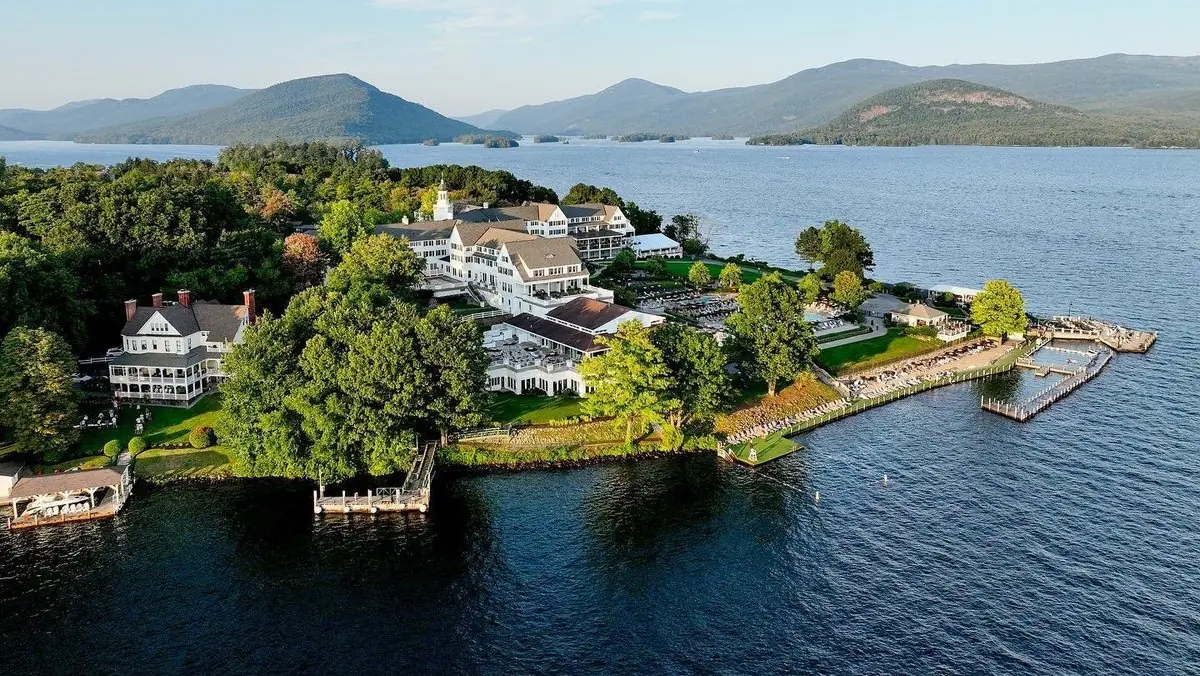
A historic Victorian-era resort occupying a private 70-acre island on Lake George in the Adirondack Mountains, operating since 1883. The property features grand historic hotel rooms, condominium lodges, an 18-hole golf course, and a classic wooden-craft marina.
-
Strengths: Spectacular crystal-clear glacial water quality, classic Adirondack mountain scenery, and comprehensive island resort amenities.
-
Trade-Offs: Strict seasonal operating schedule and high summer tourist congestion along the Lake George corridor.
Big Cedar Lodge (Ridgedale, Missouri)
Spread across 4,600 wilderness acres along the shores of Table Rock Lake in the Ozark Mountains, this rustic-luxury resort features timber lodges, private log cabins, world-class bass fishing, golf courses designed by Jack Nicklaus and Tiger Woods, and a massive marina.
-
Strengths: Immersive Ozark wilderness design, exceptional fishing and outdoor programming, and robust family recreation infrastructure.
-
Trade-Offs: Table Rock Lake experiences heavy recreational motorboat traffic during peak summer weekends, creating choppy surface conditions.
The Lodge at Whitefish Lake (Whitefish, Montana)
Positioned on the shores of Whitefish Lake near Glacier National Park, this mountain-lake resort provides a seamless blend of alpine timber architecture and pristine freshwater access, supported by a full-service marina and luxury spa.
-
Strengths: Dual-season appeal (summer lake sports and winter skiing at nearby Whitefish Mountain), crystal-clear alpine water, and proximity to Glacier National Park.
-
Trade-Offs: Short peak summer swimming window due to mountain water temperatures, and high regional lodging demand.
Grand Hotel on Mackinac Island / Lake Huron Regional Counterparts (or similar regional lake icons) — Focus on Lake Winnipesaukee icon: Moulton Farm / Mill Falls at the Lake (Holderness, New Hampshire)
Situated on the shores of Squam Lake and Lake Winnipesaukee in New Hampshire’s Lakes Region, this classic lakeside village resort network offers intimate New England charm, stone hearths, and direct access to pristine glacial waters.
-
Strengths: Authentic New England lake culture, protected pristine watersheds, and excellent boating navigation.
-
Trade-Offs: High seasonal summer traffic on surrounding mountain roads and limited expansive white-sand beach acreage.
Realistic Decision Logic for Property Selection
Matching traveler preferences with freshwater resort archetypes prevents frustrating mismatched expectations:
-
Prioritizing Crystal-Clear Glacial Swimming & Historic Elegance: Select properties on Lake George, Lake Winnipesaukee, or Flathead Lake. These oligotrophic glacial lakes offer unmatched water clarity and classic New England or Northern Rocky Mountain charm.
-
Seeking Comprehensive Motorboat Infrastructure & Championship Golf: Choose Lake Oconee or Table Rock Lake. These engineered reservoir systems provide extensive marina slips, stable deep-water navigation, and integrated golf facilities.
-
Targeting Dual-Season Alpine Adventure (Lake & Mountain): Deploy Whitefish Lake. Positioning guests on an alpine lake near national park boundaries combines summer water sports with world-class mountain recreation.
Detailed Real-World Scenarios and Operational Stress Testing
Examining how freshwater travel plans behave under real-world operational stress exposes hidden vulnerabilities in dockage reservations, water-level fluctuations, and seasonal weather transitions.
The Summer Drawdown Dockage Disruption
-
Constraints: A traveler books a summer lake vacation at a reservoir-based resort, bringing a private powerboat to utilize the property’s slip rentals.
-
Decision Points: Booking without verifying the reservoir’s historical late-summer drawdown schedule with the resort’s marina manager.
-
Failure Modes: Severe regional drought forces the upstream hydroelectric authority to execute an emergency water release, dropping the lake level by four feet two weeks before arrival.
-
Second-Order Effects: The resort’s floating docks become grounded in shallow mud flats, rendering boat slips unusable and forcing the traveler to trailer their watercraft to a distant public deep-water launch.
Weekend Motorboat Congestion on Multi-Use Lakes
-
Constraints: A family books a relaxing, quiet paddleboarding and swimming retreat at a popular recreational lake resort during the peak July Fourth weekend.
-
Decision Points: Selecting a high-traffic engineered reservoir known for high-horsepower motorboat and jet-ski recreation.
-
Failure Modes: Heavy weekend watercraft traffic generates relentless wake action along the shoreline, making calm paddleboarding impossible and muddying the shallow swimming zones.
-
Second-Order Effects: The anticipated serene waterfront experience is disrupted by ambient watercraft noise and choppy surface turbulence, highlighting the importance of selecting low-horsepower or protected-bay lake properties for tranquil getaways.
Algal Bloom and Watershed Water Quality Advisories
-
Constraints: Guests check into a lakeside resort during an unseasonably warm, humid August heatwave following heavy agricultural fertilizer runoff upstream.
-
Decision Points: Relying on standard marketing imagery rather than checking state environmental agency real-time water quality monitoring dashboards.
-
Failure Modes: A sudden cyanobacteria (blue-green algae) bloom triggers a county health department swimming advisory across the entire cove.
-
Second-Order Effects: Swimming, kayaking, and pet water access are strictly prohibited for the duration of the stay, forcing guests to rely entirely on resort swimming pools.
Unbundled Marina and Watercraft Surcharge Accumulation
-
Constraints: A traveler books an advertised “Lakeside Adventure Package” at a premium resort, assuming all water sports equipment is included in the base room rate.
-
Decision Points: Reviewing fine-print amenity inclusions versus assuming all-inclusive resort terms apply.
-
Failure Modes: Upon arrival, the traveler discovers that pontoon boat rentals cost $450 per day, kayak usage carries an hourly fee, and overnight boat slip docking adds $65 per night.
-
Second-Order Effects: Incidental marine fees inflate the checkout folio by over $1,500, straining the trip’s recreational budget.
Planning, Cost, and Resource Dynamics
Evaluating freshwater resort expenditure requires separating baseline room tariffs from secondary marina slip rentals, watercraft fuel, and seasonal demand multipliers.
Direct vs. Indirect Cost Architecture
Headline room rates represent only one component of freshwater trip expenditure. Direct costs encompass accommodation tariffs and pre-booked golf or spa packages. Indirect costs include mandatory daily resort fees, boat slip rental tariffs ($40 to $120 per night), watercraft fuel markups, trailer storage fees, on-site lakeside dining surcharges, and gratuities for marina dock hands.
In premier freshwater destinations, unbundled marina fees, boat slip rentals, and waterfront dining routinely add 25 to 45 percent to baseline lodging outlays.
| Cost Component | Budget Lakeside Motor Lodge | Mid-Tier Lakefront Resort | Flagship Luxury Lake Estate (e.g., Lake Oconee) |
| Lodging (Per Night, Standard Room) | $150 – $280 | $300 – $550 | $700 – $1,600+ |
| Mandatory Resort & Environmental Fees | $0 – $20 / night | $25 – $50 / night | $40 – $90 / night |
| Boat Slip Rental & Dockage | $0 (First-come public docks) | $40 – $75 / night | $85 – $150 / night (Full-service marina) |
| Watercraft Fuel & Rental Surcharges | Variable local marina rates | $150 – $350 / day (Pontoon rental) | $350 – $700+ / day (Tritoon/Ski boat) |
| On-Site Waterfront Dining | $60 – $120 / person/day | $110 – $200 / person/day | $180 – $400+ / person / day |
| Estimated Daily Couple Outlay | $310 – $520 / day | $550 – $980 / day | $1,150 – $2,500+ / day |
Tools, Strategies, and Technical Support Systems
Optimizing freshwater travel requires leveraging specialized watershed telemetry, marina reservation platforms, and direct property communications while recognizing their operational limits.
-
State Department of Natural Resources (DNR) Water Level Telemetry
-
Utility: Real-time online gauges managed by state and federal authorities track cubic-feet-per-second (CFS) flow rates and lake elevation levels, verifying whether water tables are stable before booking.
-
Limits: Telemetry data requires basic hydrological literacy to interpret seasonal norms.
-
-
Real-Time Algal Bloom & Water Quality Dashboards
-
Utility: State environmental protection agencies publish weekly sampling results during summer months, alerting travelers to bacterial or cyanobacteria advisories.
-
Limits: Sampling frequency can lag behind rapid weather-induced algae flare-ups.
-
-
Direct Marina Management Inquiries
-
Utility: Contacting the resort’s dock master directly verifies slip depth, electrical hookup availability, wave attenuation breakwaters, and trailer parking security.
-
Limits: Marina staff focus primarily on boat operations rather than hotel room configurations.
-
-
Satellite Shoreline & Dock Mapping Platforms
-
Utility: Cross-referencing resort addresses against high-resolution satellite imagery reveals cove protection, proximity to open-water boat lanes, and the exact distance from guest rooms to the water’s edge.
-
Limits: Satellite imagery cannot display real-time dock construction or fluctuating water lines.
-
-
Luxury Consortia Preferred Partner Channels
-
Utility: Booking luxury lakeside resorts (such as Ritz-Carlton Reynolds Lake Oconee) through preferred advisors yields daily full breakfast, $100 property credits, and room upgrades.
-
Limits: Does not discount private boat rentals or specialized marina slip tariffs.
-
-
Local Watercraft Rental & Delivery Networks
-
Utility: Renting pontoons or jet skis from independent off-site marine companies that deliver directly to resort slips often bypasses inflated on-property marina rental markups.
-
Limits: Many resorts restrict third-party commercial watercraft deliveries to protect their exclusive marina vendor agreements.
-
Risk Landscape, Failure Modes, and Compounding Disruption
Freshwater travel carries distinct environmental, infrastructural, and financial risks that frequently compound when multiple hydrological vulnerabilities intersect.
Taxonomy of Lake Resort Failure Modes
-
Dockage & Water Depth Mismatches: Reserving a slip for a deep-draft boat only to encounter low-water drawdowns that expose submerged rocks or trap propellers in shallow silt.
-
Severe Storm & Microburst Exposure: Large inland lakes generating rapid, violent wind-driven whitecap waves during summer thunderstorms, threatening docked watercraft and closing swimming zones.
-
Acoustic & Wake Pollution Surges: High-density weekend motorboat traffic generating destructive wakes that erode shorelines and disrupt quiet waterfront enjoyment.
-
Monoculture Algal Closures: Unanticipated cyanobacteria blooms rendering lake water unsafe for swimming or kayaking, ruining water-based itineraries.
Compounding failure cascades often begin with booking opaque discounted rooms through third-party aggregators without verifying marina policies. A traveler arrives with a boat and family, only to find that all slips are reserved for club members, public boat ramps are miles away, and an algae advisory has closed the swim beach.
Governance, Maintenance, and Pre-Arrival Verification Protocols
Minimizing freshwater travel friction requires executing a structured pre-arrival verification workflow prior to departure.
Pre-Arrival Lake Trip Audit Checklist
Execute these verification steps 21 to 7 days before departure to protect schedules and recreation:
-
Marina Slip & Draft Confirmation: Contact the dock master directly to confirm that your reserved boat slip accommodates your watercraft’s exact length, beam, and draft under current lake-level conditions.
-
Water Quality & Swim Beach Status: Check state environmental agency websites to confirm zero active bacterial or algal advisories for the specific bay or cove.
-
Shoreline & Elevation Audit: Verify whether the resort features gentle sloped beach access or steep stone bulkheads that might limit toddlers or elderly guests.
-
Watercraft Rental & Insurance Verification: Confirm whether resort-rented watercraft require specific state boating safety certificates or damage deposit pre-authorizations.
Measurement, Tracking, and Evaluation Frameworks
Assessing the true performance of a freshwater travel experience requires tracking quantitative cost efficiency alongside qualitative water and environmental metrics.
Quantitative vs. Qualitative Evaluation Matrix
-
Quantitative Metrics: True All-In Cost Per Waterfront Day, Marina Fee Ratio (slip and fuel outlays divided by lodging cost), Water Clarity Index (Secchi disk depth if available), and Recreational Inclusion Value Realization.
-
Qualitative Signals: Shoreline Acoustic Tranquility, Dock Maintenance and Cleat Security, Water Quality and Swim Comfort, and Service Velocity at Resort Marinas.
-
Leading vs. Lagging Indicators: Direct dock master confirmation, verified water level stability, and off-peak scheduling serve as leading indicators of success. Post-trip folio reconciliation and overall recreational satisfaction represent lagging indicators of execution quality.
Common Misconceptions and Structural Oversimplifications
Mainstream travel media frequently perpetuates oversimplifications that lead to poor freshwater resort selection and unexpected frustration.
- Myth 1: Any Large Lake Guarantees Deep-Water Boating and Clear Swimming
-
Correction: Many massive lakes are shallow, heavily silted flood-control reservoirs characterized by murky water, submerged timber hazards, and extreme mud flats during summer drawdowns.
- Myth 2: Lake Resorts Offer All-Inclusive Water Sports Like Tropical Resorts
-
Correction: Unlike Caribbean all-inclusive resorts, domestic lake resorts treat watercraft, boat slips, fuel, and specialized gear as highly unbundled, profit-maximizing ancillary profit centers.
- Myth 3: Autumn Is a Dead Season for Lake Travel
-
Correction: Autumn represents the premier shoulder season for northern and mountain lake resorts, offering spectacular foliage, uncrowded waters, mild hiking weather, and significantly reduced lodging rates.
- Myth 4: Booking a Lakefront Room Guarantees Unobstructed Lake Views
-
Correction: Sprawling lakeside properties often feature multiple accommodation tiers where standard rooms face parking lots or dense forest canopy, requiring explicit booking of “lake-view” or “waterfront” categories.
Ethical, Environmental, and Regional Economic Considerations
Operating freshwater resorts intersects directly with watershed protection, invasive species management, and regional riparian rights.
Invasive Species Management and Clean Boating
Freshwater ecosystems face severe ecological threats from invasive species like zebra mussels, Eurasian watermilfoil, and quagga mussels transported on unwashed boat hulls. Leading lake resorts invest in mandatory boat-washing inspection stations, biosecurity protocols, and aquatic weed harvesting to protect local lake health.
Watershed Conservation and Riparian Stewardship
Preserving natural shorelines through native buffer plantings rather than concrete seawalls prevents severe erosion while filtering agricultural runoff. Supporting resorts that practice responsible watershed stewardship ensures that American freshwater lakes remain vibrant, clear, and ecologically resilient for generations to come.
Conclusion
Evaluating the best lake resorts in the United States effectively requires looking beyond promotional summer photography, glossy brochure copy, and superficial acreage claims. Achieving true aquatic recreation, environmental tranquility, and financial predictability demands an analytical approach grounded in evaluating riparian rights, water-level volatility, marina infrastructure, and unbundled trip costs.
By applying structured evaluation frameworks such as the Shoreline Development to Usable Water Ratio, the True Net Freshwater Stay Cost Metric, and the Hydrological Volatility Index, travelers and trip planners can match freshwater property characteristics to their exact recreational preferences and budget parameters. Combining direct marina verification with watershed-aware scheduling and pre-arrival logistics verification ensures a smooth, inspiring, and transparent freshwater travel experience.